

Somewhere between the coastal American concrete jungles of New York and Los Angeles lies the city of Omaha, right in triple-landlocked Nebraska. A proud home to some, a “fly-over state” to others.
With the greater Omaha area hitting the one million population milestone (roughly half of the state’s total) this year, the town has grown to become a lively urban center of business, entertainment, and the arts, smack dab in the middle of the American Great Plains. Right on the central United States intersection of I-80 and I-29, those passing through can expect the amenities and influence of a major American city with a uniquely ever-present small-town Midwest charm. “Nebraska Nice,” some would call it.
The Big O. The Silicon Prairie. The Blue Dot. Whatever unofficial alias you prefer, these nicknames summarize Omaha pretty accurately. All are based around one observation: the juxtaposition of the city with its residing state.
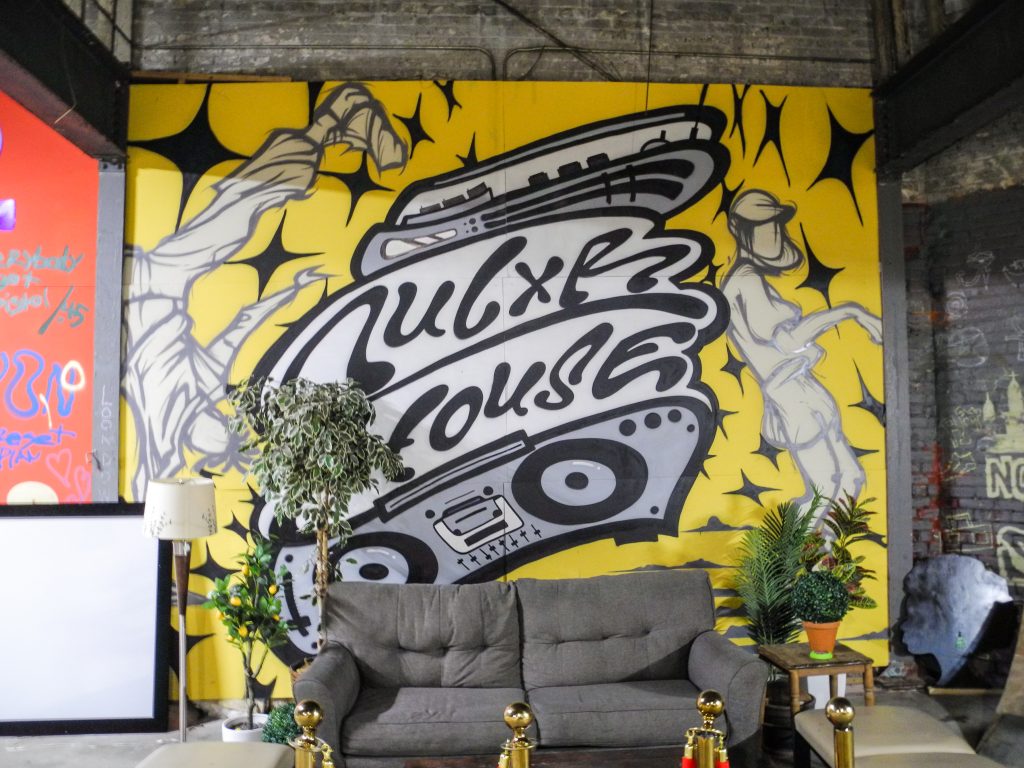
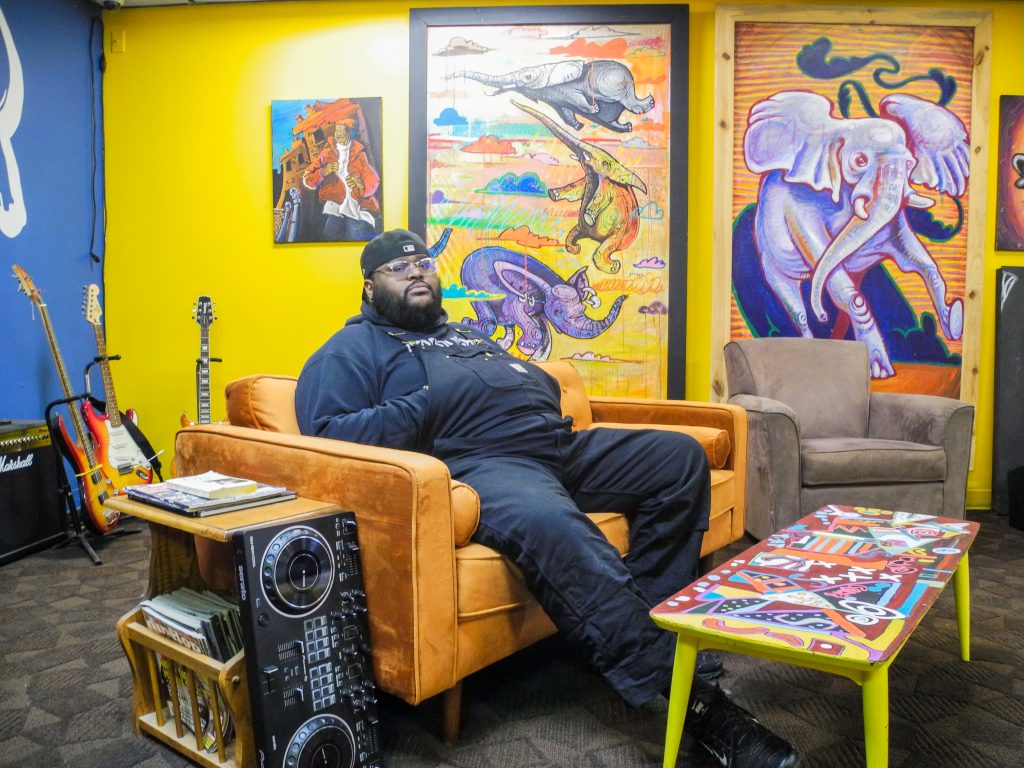
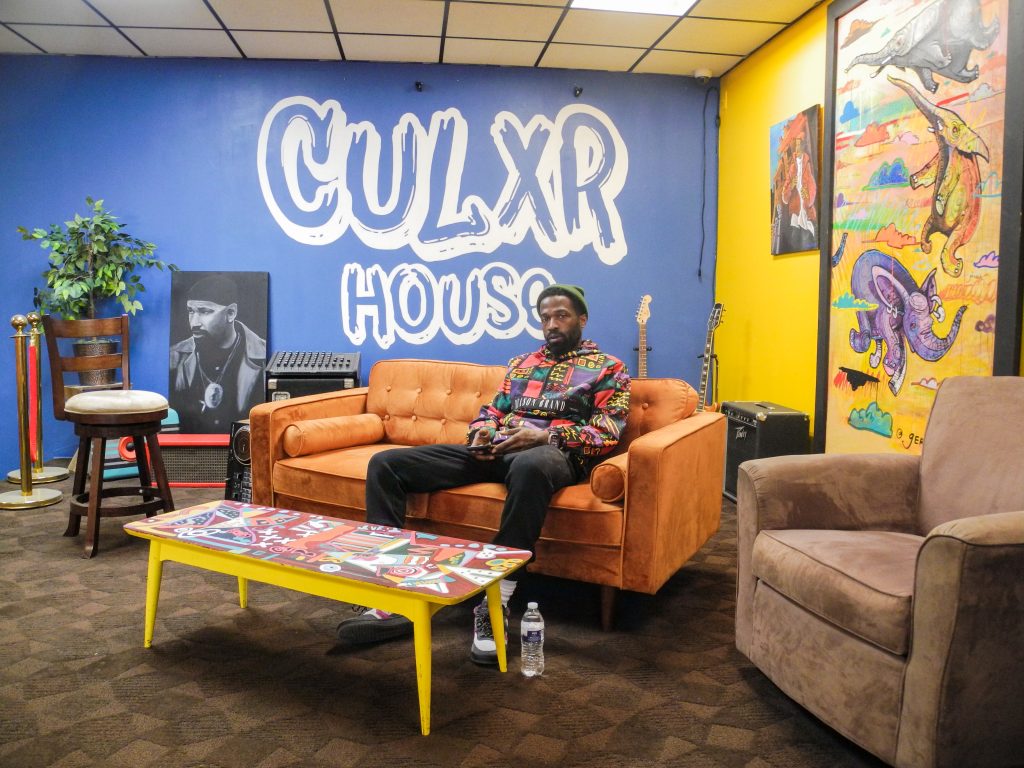
Looking to tame my curiosity about Omaha’s hip-hop scene, I arrived at Culxr House on a sunny Saturday morning to begin my deep dive into the local rap rabbit hole. Established in 2019, the creative space has quickly become an active community hub, celebrating the urban arts and providing resources for many of the city’s current hip-hop acts. Marcey Yates, artist and founder of Culxr House, welcomed me and helped me get situated.
Inside was full of striking visuals: bright colors and hand-crafted decorations on nearly every surface. The entrance and main indoor area were filled with musical treasures, including records, instruments, and a main stage. The plush, logo-embroidered rug and sets of couches throughout the carpeted room gave it a cozy lounge feeling, and the back warehouse, where larger concerts are hosted, was coated wall-to-wall in murals from many of the city’s talented minds, including Marcey himself.
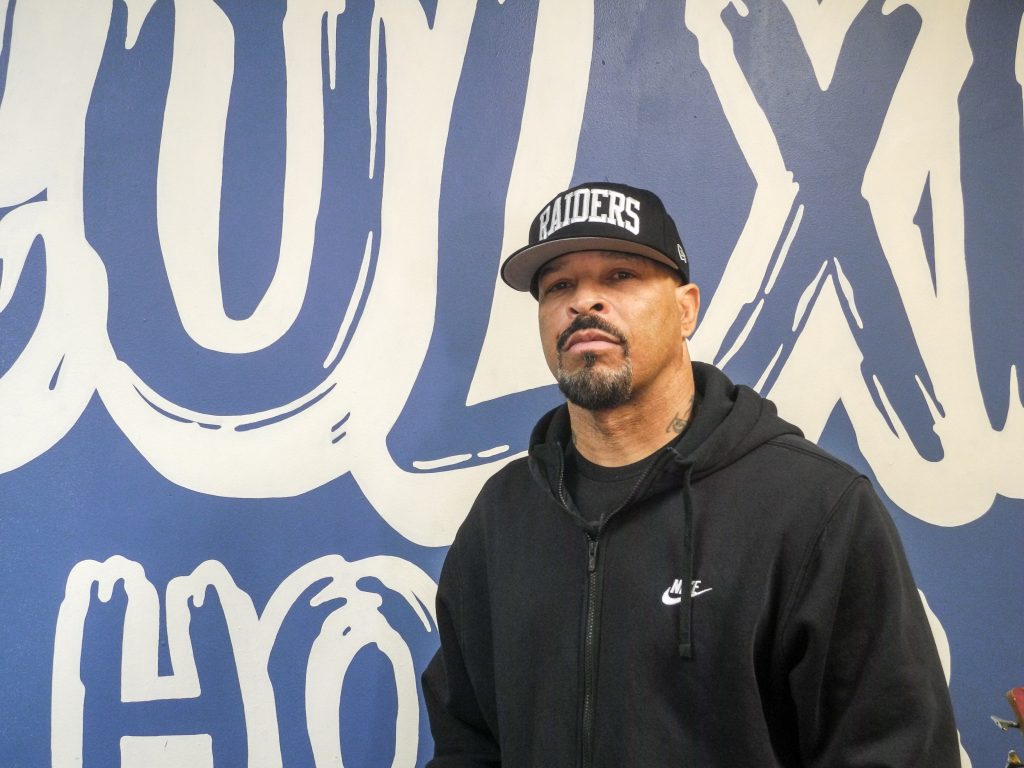
After I toured Culxr House, J. Crum and EDDIE North, two other Omaha-based artists, arrived in the lobby. Along with them came local DJ and radio host Houston Alexander, bringing wisdom and unique insight from both a nationally-recognized UFC career and a lesser-known past tenure in the Omaha hip-hop scene longer than most of us had been alive.
“Do you want to focus more on hip-hop music, or hip-hop culture?” he asked, presenting a pivotal guiding question for this piece before we proceeded.
Houston made it clear Omaha has both, and lumping it all together so loosely would be a common mistake of ignorance, one that plenty of other publications had made in the past. “Rap is something you do, hip-hop is something you live” said a voice from Houston’s phone speaker, quoting KRS-One. Michael Dunham Jr., recognized by many as “DJ Rip,” was joining the discussion via phone call.
DJ Rip, one of the early practitioners, began his hip-hop journey in 1984—“second generation Omaha hip-hop, third generation hip-hop,” as he described. Shortly before Rip, legends like Brian B, Mario Scratch, Dancin Bear, DJ Suicide, The Star Steppers, DJ Real, and DJ Mista Soull—just to name a few—made up the “first generation” of hip-hop in Omaha.
Fast forward to today, to a whole table of individuals who lived hip-hop culture, and I could have been there for days trying to cover it all. For now, I’m mostly concerned with their art—the “something” that they do.
As far as the music goes, DJ Rip and Houston Alexander had a similar, distinct description of the sound of Omaha, along with much of the Midwest: “Gumbo of all sounds.”
In the middle of the map, inspiration wasn’t in the form of a regional alliance—rather, it was from “rhyming the way you want to rhyme,” as Rip put it. Omaha is no more East Coast than West Coast, and it isn’t quite the Dirty South either. This became Omaha’s advantage. They embraced the experimentation of lyrical delivery and production techniques, understanding that the coastal chess match isn’t necessarily their battle to fight in, but instead one to draw influence from. As hip-hop evolved, Omaha grew with it, slowly adding the various ingredients to its own cutting board. Over the decades, they soon found their own recipe, featuring only the finest of geographical flavors. But to bring hip-hop deep into rural America, it started with a slow boil.
The B-Boy Language
Dallas D was the first rapper from the city to get a hip-hop recording arranged and laid down on wax. “Super Def Rhymes” was released in 1986 by the Fresh Brothers Incorporated, his group at the time, and while the record itself was birthed in Dallas, Texas, its release shone a light on how far an emcee from Nebraska could go.
But why go? At this point, the hip-hop cultural flame had been ignited back home, and Omaha was becoming fully engulfed in the nationwide phenomenon. Around the same time “Super Def Rhymes” was released, The Young Rebels (formerly The Fort Street Breakers) were making a name for themselves in the city, still following the New York influence that captivated the nation originally. Think breakbeats, turntables, scratching, sampling old records. Groups like Grandmaster Flash & The Furious Five and Run-D.M.C. had laid a blueprint that the rest of the country was following throughout the mid-to-late 80s. The Young Rebels’ initial crew consisted of Fresh Stretch, DJ Real, DJ Mista Soull, The Mighty Bear (Dancin Bear), Kid Ice, Mac-10, and Mouse. Following the eventual departure of Fresh Stretch and Kid Ice, DJ Rip would go on to become the group’s final member. Their mission was simple: “Making music that sounded like what we thought people would love.”
Rest in peace to Nathaniel Gilreath and Joe Jordan, “The Mighty Bear” and “Kid Ice,” who have since passed.
After briefly shopping for a record deal out in New York at one point, The Young Rebels returned to Nebraska without putting pen to paper, but they were far from empty-handed. They quickly became the forefront of hip-hop’s presence in Omaha, getting buzz through DJing local house parties, rocking music venues throughout the city, and even opening for touring superstars like Ice Cube.
More Ingredients In The Melting Pot
While the East Coast influence that birthed the “b-boy era” of breakdancing and early boom bap would stick around for a while, the late 80s introduced another pivot to the sound. The 1988 film Colors, featuring Ice-T’s iconic accompanying theme song, helped introduce the gang culture of Los Angeles to the rest of the world, for better or worse. Crips and Bloods no longer resided solely in Orange County; the feud gained a nationwide presence. At the same time, the mainstream approach to hip-hop faced significant and dramatic adjustments. “Palm trees, beaches, oceans, and gangs. That was coming through the music,” said Rip, who had a front-row seat to watch this unfold in his city.
Rap music from the West was beginning to hit the mainstream airwaves, and this style started to feel “close to home” for many local acts. Despite the g-funk movement being primarily rooted in California, many well-known funk artists came from the Midwest—Bootsy Collins, Zapp, even the Jackson family. It was only natural for Omaha to connect quickly.
Doezha Mac’n, Fready Dead, Pocket Pete. Notice a trend? These Omaha-based rappers fully embraced the West Coast influence in their music, right down to their stage name. Still, the hometown loyalty was ever-present, like Doezha Mac’n’s nod to the northside on 1996’s “Name On The Wall” with an album cover slogan: “Putting North Omaha, Nebraska, On The Map.” It was pure g-funk at its core, filled with smooth gangbanger ballads that you might expect to hear on the 405 near the California beaches, rather than I-80 near the cornfields.
Radio stations of the ’90s hadn’t quite bought into hip-hop, at least not like the ’80s, leaving DJs, magazines, music videos, and passionate enthusiasts with the heavy lifting of pushing the sound forward. Then there was Leola’s Records and Tapes, a Black-owned music store in the northside. Leola McDonald had run the store since 1975, and by the ‘90s, she had established some close bonds with the local independent distributors. The store soon became an unofficial headquarters for the regional hip-hop scene, opening doors for many of the homegrown artists within the country’s heartland, while also conserving history by helping prevent much of the city’s artistic output from being lost in time without proper distribution.
Houston broke it down to us: “You got 20 CDs—you took them to Leola’s, [then] got your money and consignment when your 20 CDs sold out. She gave you your dust, and you was out. You re-upped; went right back to the store.”
Beyond giving local artists an outlet, Leola’s Records exposed the city to further evolutions within rap music. Despite much of the industry residing in either New York or LA, innovation resides wherever inspiration lies, even if it’s sprinkled throughout Middle America. First, the South bubbled over. The word-heavy punchlines, infectious basslines, rise of crunk— and who could forget the infamous, borderline comical cover arts? Groups like Outkast and Three 6 Mafia were gaining attention in both the underground and mainstream, finding their way onto the shelves of stores like Leola’s.
Soon after, the Midwest entered hip-hop’s territorial game with a few unique approaches. Some maintained a close allegiance to Eastern influence, like Common and Kanye West. Others, such as Twista, Bone Thugs-n-Harmony, and Tech N9ne, brought fast rap to their core sound. There were also the worldwide superstars like Eminem and Nelly, pulling further eyes into regional output. Leola’s records, of course, stocked it all, helping raise the next generation of Midwest hip-hop right there in the heartland.
Y2K
In the early 2000s, Hot 107.7/97.3 was considered “the urban station,” and one of only a few commercial hip-hop stations in the city going into the new millennium. What started as a small radio broadcast from Blair, Nebraska (population: 7,967) quickly became one of the biggest hit stations in North Omaha, where it split a signal. Pre-107.7 acquisition, 97.3 sought to form a sort of rivalry with another on-air opponent, 94.—“the rhythmic station.” Bizzy B, a DJ and longtime associate of Rip and Houston, recruited the former to join the new station after landing himself a program director opportunity.
Bizzy and Rip began in administrative roles, but helped with curating the new station’s success through their articulate music selections. By this point, the two had decades of experience with hip-hop music. However, “hip-hop” to the former b-boys had a much more traditional, rooted feel. Despite the Billboard charts favoring otherwise, the emcee-centric “boom bap” sound, reminiscent of the genre’s golden age, quickly made its way into the local airwaves and into the northside’s speakers.
Houston eventually got his own airtime on Hot 107.7 and has remained active on the radio ever since. Currently, he’s on 89.7 The River with Culture Shock Radio, giving listeners highlights of hip-hop history through music and discussion. “Even though we have all these different outlets, there is nothing like hearing your music on the radio,” Houston boldly stated, a take that the group shared fond memories over. “That was my main contribution to our culture, rap-wise.”
Nostalgia was in the air, and these three went on to open many doors for many people. Rip’s industry involvement led to the launch of The Spin Firm, managing a few artists and brands, including Eric Sermon, The Core DJs, YoungBloodZ, and Grandmaster Flash himself. Meanwhile, Houston kicked off the Culture Shock Tour, which brought hip-hop knowledge to young minds in the region for 22 years and counting. This is also how long he’s stayed in radio, prioritizing local releases whenever possible. Like many DJs, he had become an avid collector since his days in the Scribble Crew, with a historical archive of the many rap records circulating in Omaha. “The only reason why we had local [hip-hop] on the radio is because I was in those meetings fighting for us. For real,” said Houston. “I was in the meetings telling them, ‘We need our people on the radio too!’”
Tuesday Night Titans was another product of Houston’s radio presence and Rip’s DJing prestige, where the traditional emcee was able to showcase their skills as a pure, raw rhymer—the root of the sport was often buried between the commercial and street selling points. Houston’s radio influence was starting to extend beyond just that of a typical show host. Back in the 80s, he and Rip had essentially helped fan the flame of hip-hop in Omaha; now, their job was to keep fueling the fire, a task they seemed destined for.
Finding Our Way
All the pieces were coming together. Omaha had the talent, the history, the resources, and now its own radio airtime.
“Even with that one spin every week, I made sure to play your song,” Houston recalled, as he pointed toward J. Crum, “and your song on a weekly basis,” he finishes, looking at Marcey.
Outside of their radio duties, Houston and Rip found themselves coaching the next generation on some of the rules and principles of true hip-hop. Rapping over your own vocals was a no-go. Cuffing the mic wrong would be quickly corrected. Emceeing was a sport, and a competitive attitude was necessary to succeed. As they continued their involvement with the community, the fruits of their labor since the ‘80s all seemed to finally cultivate into a carefully-crafted dish, hot and ready to serve. “Once we got into the 2000s, going into the late 2000s, Omaha found its sound and found its way,” said Rip, “because there was no reason to follow New York, the West Coast, and the South anymore.”
Mars Black was among the first notable new-age rappers to craft a portrait of the Omaha sound—an experimental blend of multi-regional sonic influence with the raw, ambitious energy of the emcee era. He signed with Team Love Records in the early 2000s, and by 2005, he had released his debut album Folks Music. The production, largely done by DJ E.Babbs, places Mars’ hard-hitting lines in a blend of NY-inspired DJ techniques mixed with the sort of indie, dark undertones that brought places like Memphis and Kansas City into the spotlight.
A key feature of Mars’ catalogue is its perceived allegiance to the musical styles of hip-hop’s golden age and his admiration for some of the core principles of rap. Stay Black, his follow-up album from 2008, dives even further into this concept, sounding like an underground gem pulled straight from the 90s East Coast. It’s worth noting Team Love was based in NY, and Mars spent many of his recording sessions there, likely bleeding some additional ink onto the homegrown success story he was writing. Still, there are more Nebraska references in his verses than you might have thought existed in rap music at the time, such as “A Cornhusker cat, nice with the renegade. Wore Husker black, knock your ass off the fade” from “Scotch on the Rocks” and “We from Nebraska all we got is beef” from “Rollin’ Deep.”
While Mars Black was helping represent Omaha hip-hop in the new millennium, Yates was just finishing up his high school years in the same city. He went on to pursue a degree in audio engineering, starting in familiar territory at the University of Nebraska-Omaha before finishing in Arizona. Yates was an emcee at heart, freestyling with college buddies daily, but learning the tools behind music production molded him into the multi-faceted artist he became.
Going by his current producer alias Op2mus at the time, Yates entered the early 2010s with newfound experience from high education and even higher ambitions. His early output flexed his abilities as an emcee and producer, along with a DIY approach to artistic expression, which he still seems to prefer to this day, with nearly all of his releases being self-produced. His musical influences stem from the likes of the Soulquarians, with the biggest personal impact coming from Common and J Dilla, who also hail from the Midwest by way of Chicago and Detroit. The conscious, soulful sounds of the Great Lakes states resonated closely with Yates, though he drew inspiration from East Coast boom bap through artists like Pete Rock and Mos Def. This may have been passed down from guys like Mars Black, whom he would go on to collaborate with on “Flamboyant Gods” in 2014.
The blog rap era gave rise to the alternative horrorcore-adjacent rap collective, with groups like Funk Volume and Strange Music developing their own cult followings. People tuned into the speedy flows, cutthroat lyrics, and the “Midwest Chopper” rapping style coming from artists like Kansas City’s own Tech N9ne. Just about three hours north of there was Omaha, where King Iso and frequent collaborator Snake Lucci began their careers following this new blueprint of an independent rapper. This lane would pay off for King Iso, as his consistent output since 2013 eventually caught the ear of Tech N9ne, who would go on to sign him to Strange Music in 2019 and later feature him on the viral hit “Face Off”—the song with a verse from Dwayne “The Rock” Johnson, if that rings a bell.
With the digital age upon us, proper music distribution and promotion are much more achievable for underground artists across the globe, and someone’s next favorite artist could be found virtually anywhere. This benefited Omaha artists, of course, along with the growing local support and significant resources arriving in the city. Make Believe Studios, opened in the early 2010s, became a new high-tech recording spot for many of the city’s talented musicians, with Make Believe Recordings serving as their in-house label.
One of their initial acts was Conny Franko, who went by Conchance at this point in his career. He helped the label put out their first official release in 2012, then went on to partner with Omaha producer Haunted Gauntlet to form M34N STR33T in 2014. Remaining active ever since, Conny would go on to release a handful of projects, both as a solo act and as one-half of M34N STR33T. His distinct pen and top-notch lyricism resemble those of other wordplay-heavy artists, like Eminem and Lupe Fiasco, who are also from the Midwest. When mixed with the underground, alternative production that Haunted Gauntlet often provides, the music gives a feeling similar to that of Aesop Rock or Earl Sweatshirt’s early days.
Meanwhile, Yates and fellow homegrown emcee XOBOI began collaborating frequently, starting up the Raleigh Science Project collective and soon forming a group called the Dilla Kids about halfway through the 2010s. XOBOI provided a sharp vocal delivery over the sample-heavy soundscapes. Yates was becoming a well-established rapper and prominent beatmaker in the city, an entrepreneurial spirit that helped him get involved with further community projects and musical growth efforts within Omaha. One project was organizing the New Generation Music Festival, an annual weekend event for musicians of the surrounding areas to take the stage in Omaha’s Aksarben Village. Although it only stuck around for a couple of years, the lineup featured a stacked deck of area talent and even booked the legendary Rakim for the 2017 season. Along with Yates’s own Dilla Kids, other local acts involved included Conny Franko and J. Crum.
Born in Detroit, J. Crum moved to Omaha at a young age and has remained here since. He came from a strict religious background at home, not uncommon for many raised in the “traditionalist” states. Christian rap was an early influence during his upbringing, though he’d sneak in the occasional Outkast CD when his parents turned a blind eye. His involvement with the church helped foster his musical passions through various talent programs, most notably a cross-country ministry tour that gave him early experience with performing on the road. While helpful for development, cathedral and community center shows could only draw so many hip-hop fans, believe it or not.
J. Crum made a career pivot around 2015 and became more involved with the greater rap community of Omaha, while still mostly remaining a Christian-based artist until a 2021 spiritual transition. He went on to start Streetlight Sounds, his own label and creative firm, and made valuable connections with Houston and then Yates, with whom he would later go on tour with.
Crum’s mention of Kanye, Lil Wayne, and Q-Tip as major influences made a lot of sense, as his sound is a little bit hard to fit under one box. Upon his debut with Flawed EP in 2017, J. Crum was a product of the melodic trap era to a certain degree, while also combining some East Coast energy and conscious, faith-based lyrics to complete the final musical output. Many quickly took notice and admired his unique style, including the recently-established Omaha Entertainment and Arts Awards, which would go on to give him several nods in their Best Hip-Hop/Rap category. Crum won the award a few times, for better or worse—he recently expressed disappointment in his win at the 2025 ceremony, as he had been noticeably less active with releases and performances.
“When we talk about [local hip-hop] responsibility, I think that’s where that probably comes from for me,” said J. Crum, as we all spoke more about the award’s varying integrity. “I wanted to speak out because I do care about Omaha hip hop. If somebody’s going to come into what we do and give us awards for what we do, y’all need to have people there who represent us. Who are intentional about our scene.” While still an honorable achievement, the group agreed that an artist’s personal involvement with the community is much more important, something that may not always come with its own trophy.
Into the Current Decade
As the current-millennium’s “Roaring Twenties” began, Omaha hip-hop had a promising yet challenging future ahead.
On one hand, its existence became undeniable, with an abundance of talent and a wide range of acts finding regional and national exposure. The 2018 J. Cole-produced documentary “Out of Omaha” helped kickstart new career paths for contributors like Scky Rei, another Omaha-born artist and OEAA winner. Culxr House was born as Yates invested back into the community with his own vision for a multipurpose creative space to support the arts in all forms. Even gangster rap had stuck around, with artists like TayFoe and SteeloTooFooly bringing a YG-inspired West Coast sound that dominated the late blog rap, early streaming era.
On the other hand, some significant obstacles were presenting themselves. The Waiting Room, which had long been one of the go-to performing venues near North Omaha, decided to stop hosting local rap altogether after a shooting occurred during a 2019 show. The COVID-19 pandemic slowed the music and performance world altogether, with a now-struggling hip-hop scene soon being phased out of city radio entirely, despite Houston’s best efforts. The unjust killing of George Floyd in 2020, then Omaha’s own James Scurlock, gave organizations like Culxr House a new responsibility of organizing and taking action during a nationwide summer of protests.
Culxr House:Freedom Summer was one of the products of this tense, yet enlightening period of time in American politics. Released and distributed in 2021 through Omaha’s Saddle Creek Records, the 11-track collaboration album featured the unofficial Culxr House collective of artists, musicians, and activists who became closely associated during the eventful year prior. The long list of those involved includes Yates, XOBOI, J. Crum, Conny Franko, and even Mars Black.
The songs birthed in these sessions gave a sense of unity, with many captivating ballads of personal expression found over Yates’ lush, soulful production. The jazzy melodies felt like an ode to North Omaha’s extensive African-American musical history, and the dense lyrical content brings a sense of both community and camaraderie. Not only was it an album-length rap cypher with some of the city’s most notable current emcees, but it also represented what Omaha hip-hop had become over the years, both in its multi-layered artistic direction and its desire to bring about something greater. By Omaha, for Omaha, undeniably Omaha.
The rap superstars of the 2010s were now the industry moguls of the 2020s, with highly revered legends like J. Cole and Kendrick Lamar inspiring the next generation who had grown up with their music. EDDIE North was part of this generation, who comes from a hip-hop family lineage. Both his father and brother were involved in the local scene during the Hot 107.7 era with Houston. Being a writer at his core, his biggest attraction to the artform came from its storytelling, a great power that he feels also comes with great responsibility. He quickly identified with the “voice for the voiceless” role that some of the all-time greats like Nas and Tupac had achieved with their music.
Hell of a Life, his third and most recent release from late 2024, is another sort of narrative documentary on what lies within Omaha’s underbelly. The project’s dense written content reaches new heights when paired with laidback, carefully curated production. His focused, impactful verses mixed with his ear for what’s “wavy” solidify his belonging in the current era. Despite this, he continues to rhyme like he has something yet to prove. In his eyes, he probably still does.
“I want it to sound good [and] feel good, but when you listen to it, it’s like ‘Damn, there’s some real shit going on,” EDDIE described his recent music. “There’s a bunch of shit in Omaha that’s not being talked about, so much stuff that goes on in the shadows, that doesn’t get brought to light.” He brought this theme further home on the album’s title, with “Hell of a Life” being a play on one of Nebraska’s state slogans: “The Good Life.”
It’s been a busy time for a few other familiar faces as well. King ISO and M34n Str33t had late 2023 drops with iLLdren and GIALLO, respectively. J. Crum put out a collaboration with Lite Pole the following summer. Yates’ 9 Months came at the final buzzer of 2024, then was followed up with House Rules in November. Culxr House has remained quite busy, recently hosting a homecoming return for Omaha native Cornfed Ted, LA-based rap artist and owner of Teds Budz, along with countless other shows, gatherings, and album release parties throughout the past year.
What the Future Holds
With many ingredients stirring within the gumbo pot of Omaha rap today, the specific taste that arrives with the dish can be a little difficult to boil down.
Still, with emcees of countless varieties coming out of the city, Omaha hip-hop seems to have at least one common denominator: its emphasis on storytelling. This is evident with Yates, Crum, and EDDIE, along with the many emcees before them. Each verse paints a vivid picture of the lifestyles they have come to know, lifestyles that are wildly different from each other, especially the Northside. There is a lot going on and plenty to be told, with rap being our preferred mnemonic device since the Rip and Houston era.
“Omaha’s like the Twilight Zone,” said EDDIE, who had tackled this concept in his most recent album. Plenty of narrative-worthy events are unfolding in all corners of the ever-growing city, many of which are very unique from the last. “The kid from Omaha” isn’t a singularly defined role, but rather a mixed cast of characters, archetypes, and experiences beyond what the passive listener might expect from any sort of corn-centric cinematic universe, as one could call it. Each project is a new episode, describing a new series of unusual events from a unique perspective.
Along with EDDIE, Qu33zy is another one of Omaha’s younger, next-generation emcees. Qu33zy has been making music since high school, and recently finished up his audio engineering degree at one of the local colleges. While his time in school gave him opportunities in all directions, Qu33zy clung tightly to hip-hop. Among other gigs, he is also the Sound and Operations Manager at Culxr House, which caught his attention early on by accident, thanks to a last-minute venue change that brought one of his shows there.
Hip-hop had been instilled into Qu33zy by his father, an avid listener from Illinois, and he had even planned a move to Chicago to pursue the music industry after college. That is, before he realized the opportunity he could be a part of back home. “We’re doing a good job of keeping that momentum going,” he said about the current scene. “It’s just that more of us need to get that promotion, get that recognition. There are a lot of cats out here that are giving that raw Omaha sound; they just don’t have the recognition that they deserve.”
Ciara Lee-Blackstone couldn’t agree more. Growing up in the city, she eventually relocated to Los Angeles for a little under a decade to work in the music industry, during a time when a content-related profession like hers wasn’t nearly as prevalent as today. Currently, as one-half of the Omaha-based Streets A&R Podcast, a show about the regional urban music scene, she’s been working to combat this.
“I was involved in some of the inner city communities within LA… it made me realize how much of a golden market Omaha was,” explained Ciara. “I felt like deep down, if there was some sort of music scene that started to emerge in Omaha, I would feel bad for not being a part of it, because I was born and raised here.”
While helping revive Streets A&R Podcast, Ciara also founded Knob Ties, an Omaha-centric hip-hop magazine covering artists, DJs, and community resources. According to her, these are now two of the three top urban media outlets in the city, the third being 87.9 The CLTR with the legendary DJ Mista Soull.
“I feel like the mindset for a lot of folks who weren’t in major city markets was just like, ‘I need to leave here to be successful.’” said Ciara. “I feel like once people got it in their mind that they don’t need to leave where they’re from to be successful, that’s when everybody kind of took off.”
As media outlets and spaces like Culxr House continue to fan the flame of hip-hop in their community, it’s only a matter of time before tomorrow’s homegrown superstars put Omaha’s sound in the national spotlight. A sound 40 years in the making. “I think that what we’re looking at now is a sound that builds from decades of trying to find our way,” DJ Rip said, as he concluded his phone call appearance. “Omaha is hip-hop. Always has been, and always will be.”
P.S.
As I wrap this up far too late into the night after months of research, interviews, and deep dives, I figured I would mention some additional resources that are continuing to preserve the history of hip-hop in Omaha:
Mikala Harden & The Reader | “Omaha’s Hip Hop History: Unpacking Our Past” & “Omaha’s Hip Hop Legends and Landmarks”
Hear Nebraska | A past online publication of The Bay, formerly known as Rabbie Mill
Omaha Performing Arts | Hip Hop Lab and Advisory Council
I think back to a quote from Grandmaster Kaz that Rip had presented during our discussion: “Hip-hop didn’t create anything. It recreated everything.” The sound of Omaha hip-hop is a product of nationwide musical influence, from the early breakbeat emcees of the East Coast to the new-age trap artists of the South. At the same time, it reinvented the city’s music scene as we know it and inked our chapter into the history book of what many believe is the most important genre of all time.
This grows more difficult to argue with each passing day—even in a rural state like Nebraska.