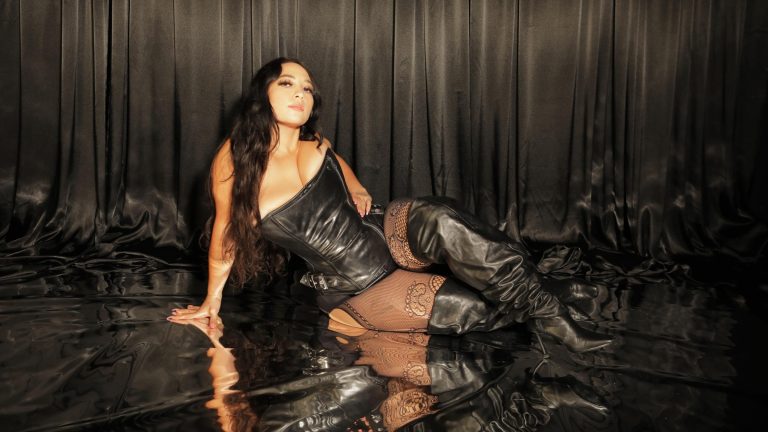
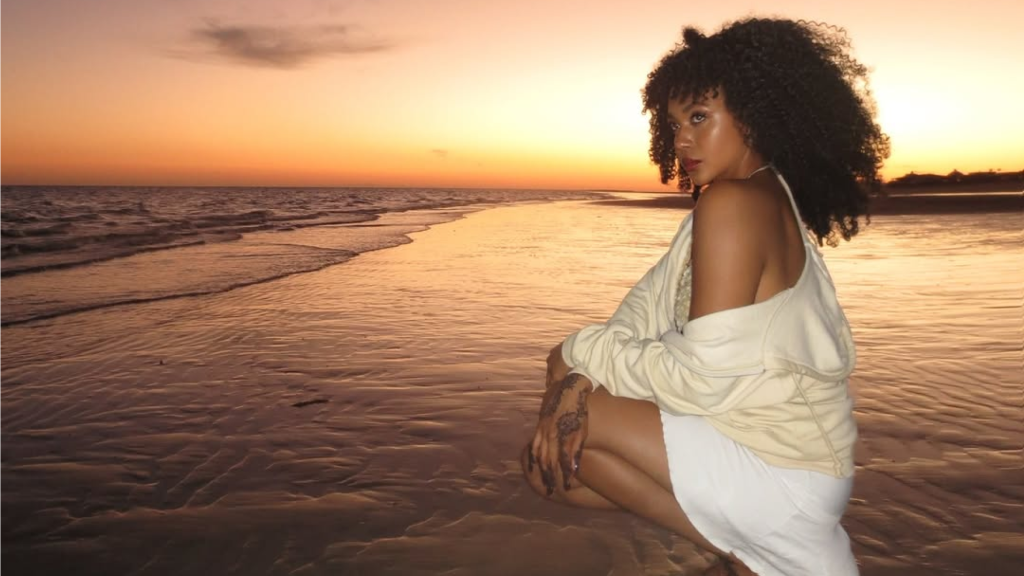

“It’s a regular colloquial, black expression that I be using when I’m deadass serious. It without a doubt captures my intensity when it comes to my pursuit of every passion of mine,” says KJADE on the title of her newest release, On Everything I Love. A Phoenix-based rapper and artist, much of her work has a distinct focus on career and community. However, this project has a sense of true authenticity, an intense yet familiar sound that reflects personal reconciliation. In her own words, “I looked at the ways I would lay parts of myself down on the line in the name of love and [inevitably] those parts of me would die… and those little deaths added up to make the album.”
On Everything I Love is KJADE’s celebratory lap, a triumph through confession. Her last album, THE SOUND THAT TREES MAKE, while grateful, had a somberness to it. On Everything I Love still holds weight, but of a trophy rather than luggage. Accompanied by very fun, lax instrumentals, this album isn’t uncertain, identifying how KJADE has grown and will continue to do so.
KJADE’s flow has always had a certain gentleness to it, recognized by herself as she said, “I never realize how soft my voice is until I rap alongside people who have hella bass in their voice.” Now, she hears “hazy and smoky” as descriptors, something fully developed through On Everything I Love’s certain strengths. Much of the uncertainty from her past projects has naturally faded with time, giving her timbre an aged assurance. Leaning into this natural maturity assisted her neurotically reflective writing style. After releasing THE SOUND THAT TREES MAKE, KJADE had a lot of time to ponder on her “powers”; these contemplative parts of her music that people connected with the most. “I developed this awareness of literally other people’s awareness of me,” she said. “It’s still new ground that I’m breaking as I grow as an artist, and it’s made me more aware of my emotional and spiritual hygiene.”
Part of parsing that vulnerability is figuring out what parts of herself she should, and can, share. “Initially, I set out to reconfigure the way that I write so I’m not bleeding all over people,” KJADE admitted. When comparing this album to her last, you can feel this in tracks like “SHE’S SO HEAVY.” A smoother, reflective track, that on THE SOUND THAT TREES MAKE may have been overwhelming with her tendency to unload problem after problem on listeners. Here, though, much of that pressure is turned outward, challenging listeners in turn with herself with breathy lines like, “you can go as hard as you want, I’m soft, and I’m better.” Her flow almost proves that with its lightness but undeniable surety, making her expression of pain much more relatable. “It feels like an unfit introduction to myself to show you all of my scars first, and thinking that defines me. Equally, it felt hard to abandon a practice that was literally all about ventilating… from the jump. I’m still working that part out.”
This was particularly important when so much of ON EVERYTHING I LOVE came from a place of hurt, best expressed on the sharp precision of “REDBONE.” The track holds some of the most specific, confrontational references to her own life, while keeping her tone even, with lyrics like, “I’m on the hunt for my rapist to kill what weapons inside of me.” Paired with the muzak-esque backing track, “REDBONE” is a waiting room for contemplation. KJADE told me, “I knew as I found myself logging all of my insights through writing that this would be the next chapter for me. Going from healing to, maybe not ‘healed’ per se, but ‘rather ready to move on and in full motion.’” She quickly reveals these parts of herself across “REDBONE,” then immediately dismantles them with allusions to problems beyond hers: “I won’t stop till we free the Congo.”
Beyond broader political statements, much of this album reckons with the practical ramifications of being an artist. The plainest example is the song “PAY ME IN PAIN,” a metaphorical map of everything KJADE has sacrificed for her career, with references to “splitting shins since the first grade” and the like. Set up as a victory lap with brassy horns opening the track, she highlights what she is and isn’t willing to give up, denouncing selling out first and foremost. Pain for profit is a common trope in rap music, something KJADE has a very practical reasoning for. She said very plainly, “I find a value in transmuting the hardships I’ve collected into something meaningful… My personal job as an artist is simply reporting my experience and defining what makes this current headspace of mine worthwhile until it develops and my life moves on. It’s just natural.” This motif translates into that of sacrifice as well, one you hear in lines like, “If I die before I wake, I will still be me.” However, in the age of musical artists as people versus their persona, KJADE had little interest in engaging with her alter ego, besides these brief allusions. Very wisely, she mentioned, “Open Mike Eagle [the rapper and producer] shared an observation the other day… ‘You don’t hear so often these artists request of their listeners to separate them from their art. It’s definitely a voluntary response.’ A lot of average people do this to grapple with the discomfort when feeling the distance between someone’s contributions to society and their personal politics. That’s nothing I expect of my listeners as someone who makes art that is naturally political.”
While this project delves into the uncomfortable, it is at its core an expression of KJADE finally feeling at ease when it comes to her self-expression. The sound feels like the distillation of KJADE’s very being, with the focus on creating a laidback ambiance rather than recognition. This is seen in the way the album itself was produced, with reverbed samplings of R&B and faded voice notes sprinkled throughout—a direct result of the development of KJADE’s mindset: “I feel like I can finally say I’m walking into soundscapes that are more relevant to me. My most recent album was approaching that, but with what I’m making now, I feel like I’ve caught up to a version of myself that I’ve only seen in my mind.” This new version is encapsulated in the passion KJADE has throughout On Everything I Love. But this passion doesn’t alienate. Instead, it’s conveyed with KJADE’s unique kind of levity, begging listeners to be brought into the fold. She explained it best herself, telling me, “The last joint elementally was so earth and water. This, to me, is pretty fiery and airy. [It] fully made space for a more colorful side of me that I don’t even think has fully come out yet, but definitely clears the air and rolls the rug to show out for my next thing.”