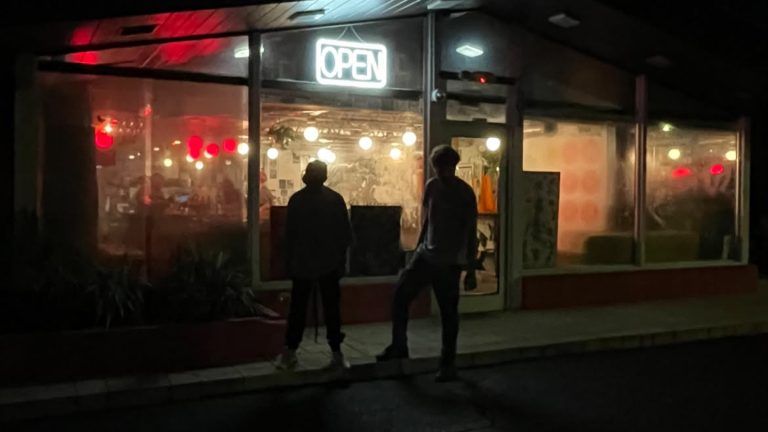


You can tell a lot about a person just by watching them. It is an old premise in the study of human behavior, one that always fascinates—especially the Florida-based producer and songwriter, fessski k. In the statement she released alongside her debut LP on Bandcamp, she describes jock as one “deeply rooted in the south, observing the characters found in coffee shops, dive bars, the local scene and her beloved community.” On jock, fesssi k. catches the ordinary at its strangest, all over fuzzy guitars, slow-burning drums, psychedelic haze, and the occasional shoegaze blur. There’s a teenage quality to the album, not necessarily in subject matter, but in the feeling of listening to something at night and believing, for a few minutes, you alone are being sung to, gossiped to; whatever you are feeling is the biggest thing that has ever happened to anyone.
Still, you could also deduce, from the way fesssi k. almost always half-sings, that she is less interested in telling you how she feels than in showing you the world as it appears to her, and the anarchy of her inner world as it unfurls—people going about their daily lives, revealing themselves in unguarded gestures, while, beneath these observations, feelings such as resentment and uncertainty jostle for space in private consciousness. Take, for instance, “southbound,” where she sings in a low, ominous register while the guitars swell around her. The track seems just like a collection of things noticed: one woman has “a baby on her hip” and is talking on speakerphone; another is trying to control a hyperactive doodle; three youths walk southbound on 34th, sweating in hoodies. There is a date, a stop at Thornton’s, a song playing over the intercom. None of it is explained, except in the tacit exposition of the ending lines, which she sings clearly enough: “Sounds like a jack knife went in / And got it good,” a sudden wound appearing in the middle of so much ordinary life, as though the unease garnered from those observations finally comes to a head.
It dawns on you that while the artist shows her hurt and malaise, inviting the whole world to gape at her wounds, she, in turn, gazes back, pointing out its vices and defects, and the question becomes: why? To even the score, or to prove she herself is not an anomaly? And to what end?
Elsewhere, there’s the question of whether it would even matter—are a person’s flaws enough to make them a villain? In “you’re no hero,” she warns over a mellow guitar progression, “Being mean to yourself won’t do you any good.” But the lyrics refuse to make their subject either villain or hero: “There’s accountability, / And there’s just bleeding to bleed,” a point that seems to matter throughout jock, and one complicating the project’s—as well as the artist’s—scrutiny of human behavior; it’s a snarky thing to say someone being hurt doesn’t necessarily make them innocent.
“stargirl,” featuring Cleo Reed, a polymath of the arts, born and raised in NYC and Uptown DC, does something similar from a different angle. The song has a gauzier, woozier style, with fesssi k.’s voice shimmering into the instrumentation until the two become difficult to separate. When the harmonies arrive midway through, the song becomes hypnotic. Meanwhile, even stranger, the stargirl is being watched. “She’s a star / A cowboy / Real bad girl,” first an object of fascination, then an uglier reality is revealed: someone using his privilege to stare at her while she works. As if that isn’t itself creepy, the stranger watching thinks: “In a sea of red / She’s within the gate / She’s unscathed / She’s unscathed.” By the end, the guitar sounds alive, like an actual person screaming inside the song. Interpret it how you want; fesssi k.’s voice, faded from the track, seemingly shrugs.
There is, after all, a kind of absurdity with the seriousness with which people regard each other, especially when their judgment reveals as much about themselves as the people they judge. “sleep better knowing” features another man, one who has a question he knows he “probably shouldn’t ask” but asks anyway. The song’s opening lines, “What you eat / Don’t make me shit,” have a bluntness that feels comic against the dismal soundscape around it. fesssi k. stretches out “shit” like she knows exactly how ridiculous the sentence is, but drives the point home: another person’s choices don’t become our own concern. That little wink matters. jock can be gloomy, but not necessarily solemn, like on “take the win,” which offers fesssi k.’s wryness, a willing attitude to accept life’s little reprieves without much protest.
The album’s sound, however, rarely deviates. A nostalgic feeling is evoked, again and again, of a rock-reigning 70s era rife with overdriven, distorted guitar riffs wailing and lingering in the air. After a while, the songs begin to bleed together. I like the slightly trippy, mesmerizing quality of the songs, the shoegaze wash and the angst hanging over so much of the record, embodied in slow-rolling drums and doleful singing drawing the songs behind a wall of smothering murk, save for small interruptions like “be gone,” whose brighter melody and upbeat buoyancy make it cheerful enough for a sunny drive with the windows down, which just makes its brevity feel like a wicked joke.
“you” might be the closest jock gets to simply letting a feeling take over; the emotional swell—first of its kind—turns into a private reckoning you can recognize yourself in. The instrumentation is familiar by this point, but her voice changes the effect. When she sings, “It’s you that’s the problem,” her voice sounds tender yet full in the delivery; the accusation becomes more devastating; it whirls you into a memory of heartache and, by design, is the one song on the album you could imagine shouting along to at a midnight concert, stars twinkling mindlessly above. Its lyrics, more decisive, “Making peace with what I’m not / Taking steps towards what I lost,” give way to the repeated indictment that this person is the problem—they are the one she no longer loves.
jock then takes a darker turn on “southern trees.” The title alone points toward Nina Simone’s “Strange Fruit,” invoking a tradition confronting the racial violence buried in America’s Southern landscape. But instead of staying with historical horror, fesssi k. paints a different picture. After images of “Bitter / And black / And full / Of seeds,” she remembers climbing the tree in her grandmother’s yard as a child, going as high as she could and jumping. The grief is still there, but so is the child who once climbed to play, without knowing what else the tree could mean.
On the cover of jock is that seven-year-old fesssi k. doing a push-up in the middle of a family gathering, completely committed to whatever strange little thing she decided to do. The record doesn’t always sound as though it knows where it is going; it has its hands full watching life as it happens. Still, jock rips open a canworm of conversations about what happens when people grow up. And what happens? They disappoint you and themselves; they become heroes and then prove they aren’t; they watch other people when they shouldn’t. And perhaps, most tragically, they fall in love, stop loving, and sometimes don’t know which one has happened until much later. Cut through the din noise, and a snarling guitar is always in the background, forcing you to sit and absorb the crash of everything all at once, prodding you with the question: didn’t you know? Sometimes simply feeling it all is the highest, most poetic gesture anyone can achieve.