
When left to his own devices as an avant-rap producer, you never know what Atlanta’s Hal Williams, aka Vritra, is going to tackle. Be it avant-funk to Vangelis-inspired beats to whatever you may categorize THIS as. But aside from being largely heady and introverted, it is also fairly intense.
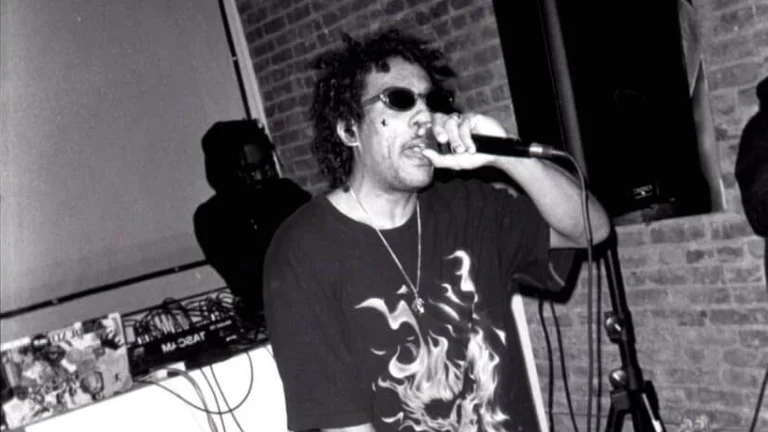
Vritra, formerly named Pyramid Vritra, is a producer and rapper who was formerly a member of Nobody Really Knows, Pyramids, and Odd Future, as one half of The Super 3 with Matt Martians. With every beat, Vritra pours out genre-agnostic contents of his mind, from feelings of true love to feelings of complete mental anguish. What remains constant throughout his music is the quiet intensity in his voice, which gives off an air so thick that when he does express anger lyrically, it instantly passes by without your full attention.
Vritra has expanded his collaborative efforts with producers outside of his aforementioned camps, such as Newcastle, England’s own Wilma Archer—formerly SLIME—to rock band Her 72 Demons. However, the latest and noted final (solo?) project, Husk, was billed as a goodbye project shaped like a tragic story. Before, he gave us the largely instrumental Odyssey, taking us back to his time in NRK and Jet Age. A little look back at the good times before the plunge.
Odyssey’s one-two punch of the slinky “Before the Fall/Square” to the off-kilter futurism of “Unrequited” demonstrates how off the beaten path he has been over the years. His versatility and outsider rap tendencies have not only set him and his peers apart but have inspired a small avant-rap renaissance around the mid-2010s.
Multiple beats on Odyssey can be found on 2012’s Pyramid. The new jack swinging “Ice Cream,” the progtronic new age melodies on “Transmutation” (formerly named “Transporition”), the acid percolation of “m48,” and the lockstep acid jazz stomp of “Svetlana.” The cloudy, alien-esque “Soul/Drain” may be the most familiar to those, as this version is Syd-free. Genres such as psychedelic rock on “Illusions/Sail” and space rock on “In the Water/Sweden” get mixed in with synthwave swirls and a jittery waltz. The commonality between these beats is feelings of unease, which eventually break down and give way to moments of synthpad-assisted tranquility. Imagine Flying Lotus in a bad mood, and you aren’t far.
Even if the closer “Howl” offers a sense of calm, the juxtaposition between synthetic serenity and anxious drum patterns remains. While the album may be a fun travel backwards in time—or forwards, depending on your perspective of the music, Husk puts you right in the middle of the present time. The anguish and paranoia Vritra addresses in his album description—and since the rise of his rap career—reaches a fever pitch.
On the opener “Prisons I’ve Designed,” bass buzzes like fluorescent lighting in a gas station bathroom, drums pound like a migraine. If depression can’t hit a moving target, then Vritra aims to shift anywhere where the voices within his head cannot aim at him. And still, he hints at thoughts of self-erasure with explicit imagery—“Break out the cage, for if you don’t you’ll end where I’ve been, slit up the seams, slit up my shell, blood on a lapel / Blood on the floor, censored the gore, what is the smell”—and worries over personal failure—“Ain’t you part of what’s a name nem team? They chain nem gleam, so what you mean you can’t afford the fee? Skill issue indeed.” For Vritra, looking back at all that he has accomplished over the years becomes an eyesore. Despite the mark he and his crews have left, he’s still not at the place he wants to be.
In what is set up to be a concept album, Husk tackles his struggles with depression. The project also introduces another component: his Christian faith. With a beat of chopped-up guitar over a Timbaland-esque rhythm, “Exile” continues the stream-of-consciousness rapping as if it’s his way of making room for mental relief. The topics that fall out include his dissonance and history with the church. Vritra speaks of coming from a “nation adjacent,” “Christian in-doctrines,” and “banishment options,” opening up the floodgates for a story where fear of vulnerability meets a reluctance to return to his faith. On the album’s straight house track “Nu faith,” it doesn’t take long before the revelation is that Vritra is inspired to follow God again. “I believe you’re the true Messiah,” Vritra convinces in a seemingly deadpan way. “I knew from the work you do inside my life.”
The album ends with a psychedelic crunch. Synths mimic bird calls, and pads provide the water’s ripple on “Look At God!,” a song he wrote from the point of view of God himself. The bass accompanying his beats no longer has tension when it rumbles. For his last album, Vritra looks into the rear-view mirror and rides into the sunset with his belief in God intact.
Odyssey demonstrated Vritra at not only his most eclectic, but also his most musically daring. Jazz, new age, neo-psychedelia, and many other genres often collide with hip-hop beats, even as he was rapping over them. But Husk is more conventional in comparison, at least by Vritra’s usual standards. If it is a house track, it is house music. If it is a dreamy track, it is dreamy music. If the genre clashes represent the past dissonance, Husk is the surrender, the clearing of the mind for peace, and maybe even recovery.