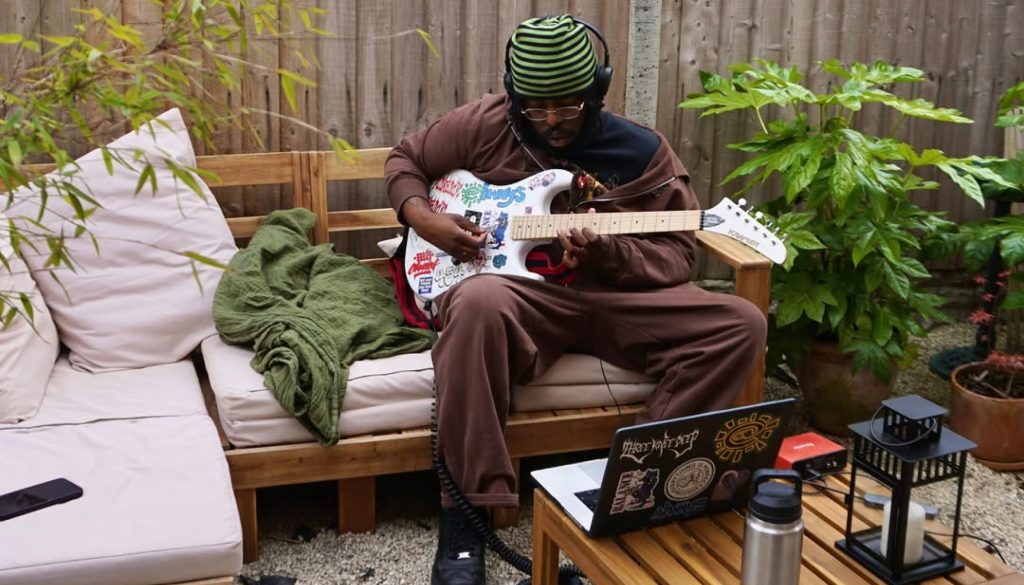

Names, names, names. What’s in a name? On My Name, Birmingham-based rapper, producer, and multi-instrumentalist Tony Bontana circles that Shakespeare-immortalized question. The album opens with a meditative poem by best friend and Leeds-based artist Izzi Richards, which all but dismisses the idea entirely: a name is something given, something used by others, something that “isn’t even mine.” Identity, then, is unstable from the start.
Bontana navigates through images of war, protest, grief, and survival with the keen perception of an astute observer. On “Soft Dreams,” mellow vocals hover in the background while his verses cut through with urgency, invoking political violence and responsibility, “Free Palestine, I could never turn a blind eye.” Never fully tipping into didacticism, and with skeletal drums and a minimal sound structure, it’s not exactly polished protest music, but feels closer to diaristic work, intensely rooted in personal experience.
You’ll find that same emotional density on “Absolution,” one of the album’s most fragile moments. With the beat drifting in a slow, hazy trap-soul palette of muted drums and blurred melodies, Bontana’s voice teeters on the edge of breaking when he raps, “My eyes weep, I can’t face it / Every level, new devils fight the arms race.” There’s no clear resolution here, no moral clarity. Even as he gestures toward absolutes, the song settles instead into something more honest: the exhaustion of too much feeling. It recalls James Baldwin’s idea that to be conscious is to live in a constant state of rage and his similar sentiment that it is that pain that makes one unique: “Your suffering does not isolate you; your suffering is your bridge.” A way to connect with humanity.
Throughout the project, distress and pressure remain a constant atmosphere—even when the tempo shifts to more upbeat tracks like “Charge It” and “Recoup”—unsettling, flavoring the listening experience with the friction between sound and subject matter. “Grief” leans more openly into resignation, with self-defeating lines (“Said I’m tryna make it work / someone’s gonna get hurt / I hope it’s me first / I’m trying my best and doing the worst”) repeating throughout while others mask the same feeling under momentum or rhythm. There’s a sense that no matter the sonic variation, the emotional core remains the same: a world that is difficult even to imagine, let alone navigate, and a self trying to make sense of it in real time.
My Name is not only grounded in struggle, but it is also deeply spiritual, as anyone can tell by the moments of gospel and blues influence that surface repeatedly. “Wherever I Go,” which could easily be dismissed as an incidental interlude, becomes one of the album’s most symbolic points. Over rolling drums, clashing cymbals, and steady, devotional vocals reminiscent of Al Green or Sam Cooke, the song creates a special kind of feeling, of carrying belief in chaos, however flickering, from one place to another. It’s beautifully intentional, especially following what feels like a prayer on “Don’t Cost A Thing,” and makes the track feel more like a crescendo than an isolated interlude.
From the album’s production, you witness slightly chaotic tension, with sounds moving between sparse then heavy drum patterns, acoustic piano riffs, dense synth textures, and blues-influenced melodies. At times, the mix feels a bit crowded, vocals competing with instrumentation. But like the idea of shoegaze, it stacks the soundscape, pushing the voice into the blur and mirroring the album’s theme of overwhelm. There’s a recurring piano tinkling across tracks like “About Face” and “October Fallacy”: high, glinting tones giving the music a slightly psychedelic, weightless quality of something always just out of reach.
The only limitation, if at all, lies in the album’s consistency. The sonic palette—cohesive, yes— never really stretches far enough to create a contrast that could make individual moments hit harder, and there are points, like between “John Osbourne” and “Absolution,” where more variation might have deepened the impact of individual moments.
Still, what ties all of this together is the album’s reorientation to identity. Early on, identity feels almost irrelevant. Now in its closing moments, “October Fallacy” reintroduces the idea of a name. What’s in a name? Over shimmering piano and a triumphant swell, Bontana has his own incisive take: a name, or his, in particular, is no longer just something given. He raps in searing style, “My name’s bad days and grey clouds / Ill weathers, stay downs / My name’s my name and my name’s mine.” Everything carried and endured.
The album closes with a choir affirming belief and love, and something beyond the self: “Believe me when I say, he loves you.” Just like that, all the fragments collide… purposing on something beyond the self; the focus shifts from individual struggle toward something more collective, more spiritual.
What’s in a name? Who knows. There’s the pithy saying, “It is what it is, and you are what you are.” Unlike names, identities are all these textures of place, culture, faith, class, survival piling on top of each other until they form something original, irreducibly yours—essentially, it is that self Tony Bontana digs into in My Name.