
By all accounts, reality is in shambles. Each new day brings a parade of grotesqueries to your phone’s lock screen, and tapping any notification opens a portal to even more horror. It all drills down to violence: the official language and main export of the United States, the glue holding empire together, the ambient feeling in the air at all times. Until they’ve invented a way out that isn’t through, this ubiquitous barbarity is unavoidable; it’s baked into every system with which we engage. If we have any hope of shedding it from our lives, we first have to confront it.
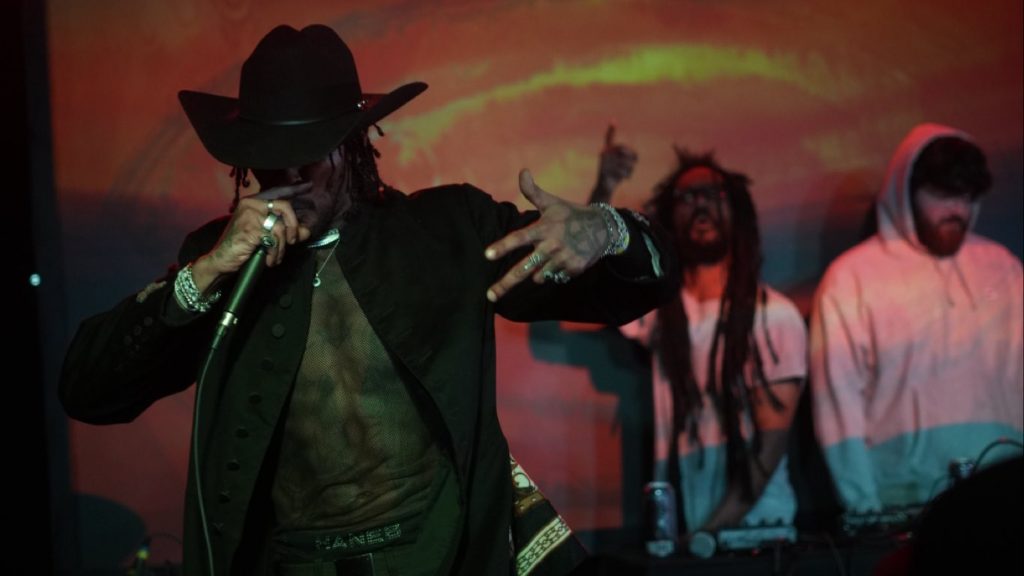
Des Moines rapper Teller Bank$ has a better grasp on this than most, repeatedly tracing the various tendrils of that violence throughout his massive, exploratory catalog. “My cousin’s pops taught me how to spot the plain clothers,” he reports on “Plain Clovers” from 2023’s aptly titled White People Stole My House: The Album. On “Demons,” a standout from 2022’s Ed Glorious-produced The I & I, he stares down the barrel of the camera, indicting his audience with an unblinking opening couplet: “You ain’t never seen a n***a die / Eyes wide, laying still while his baby mama cry.” The cover of 2025’s DRUG$$$, his first album with Philadelphia production crew $$$, features a cartoon of Ronald Regan holding a bag of crack, dunking on two Black men.
In an interview with the Rap Music Plug Podcast about DRUG$$$, Teller offered a thoughtful analysis of resistance and adaptation: “If you think about what crack was supposed to do to the Black community, it did a lot of that,” he explained. “But at the same time, look at what n****s done did with some cocaine!” He mixes personal tales and allegorical fiction like paint colors, illustrating the often brutal lengths some go to escape the crushing weight of poverty. It’s a rapturous, harrowing listen, each verse shot through with trauma and triumph, every beat knocking like a vicious headache. Despite the album’s heaviness, there’s a glimmer of hope buried beneath it all—blink, and you’ll miss Teller declaring “Never say die” on “Travk & Field ($$$).” For all of its tales of late-night hustles and deadly encounters, there’s a small, almost naive belief that hard work of any stripe will bring better days.
Hate Island, Teller’s astonishing second collaboration with $$$, is a meaner, darker affair offering a look at what happens when those efforts fail. Both versions, the one edited to fit an LP and the 26-track, hourlong Director’s Cut, play like a stress-inducing Safdie film; the characters in these songs, responding to the world’s constant malevolence, repeatedly double down on bloodshed and cruelty, always expecting a better outcome but further entrenching themselves in the cycle. The music rarely resolves, the only respite coming from the occasional reveal of a mangled sample or the few moments when Teller softens his wild-eyed yawp to a near-whisper. It’s a bleaker listen than DRUG$$$, a widescreen expansion of that sonic and thematic world. But it never pushes the audience away; there’s more than enough sugar in Teller’s transmogrifying flows and the $$$ crew’s shifting-sands soundscapes to keep you hooked into its bullet-sweating intensity.
Teller’s performance is magnetic and vibrant, combining every pattern and delivery idea he’s explored throughout his peripatetic discography. He often raps like the floor is lava, leaping across beats with a hoarse helium shout, or carefully tiptoes through a rhythm, stretching into the corners of bars while always nailing the snare. An occasional slathering of autotune renders his already elastic voice even more so, and it all adds up to a transfixing, formidable display. Teller writes like a medium at a seance, with vivid passages spilling forth as if being channeled: “All I seen done changed me, how you shame me / Blood on the leaves, blood in my eyes, I can’t see / Sun in my eyes, ultra light beam / Please, baby, no more parties in Tel Aviv,” he croaks on “Amtrak Trap Trap.” Up close, his verses read like nonlinear collections of images, compelling and highly detailed, but sometimes without a direct throughline. Take a step back, and you’ll find an impressionistic rendering of our current world, where the lurking masked shooter wearing rubberized gloves and the jack-booted federal agent demanding your papers could be the same person. When Teller yelps, “You better have it, silly rabbit” on “HATE HATE HATE,” it’s hard to tell if he’s the target or the enforcer. Brain juice and gore splash on shoes all the same.
As impressive as Teller is throughout, Hate Island is just as much a showcase for $$$’s dynamic approach to production. It’s not uncommon for committees to remotely staple tunes together through email chains and [untitled] links, but $$$, the main core of which consists of beatsmiths q no rap name, Philth Spector, Killer Kane, and ayash[!], get together in the same room to compose. Someone might bring drum sounds, someone else brings a sample, but everyone contributes to the final arrangement. For the most part, the palette is a familiar dusty boom-bap sourced from jazz and soul records, but none of these tracks rest on a single loop; samples dissolve and rearrange themselves, rib-cracking bass swallows the stereo field whole, and songs frequently reroute like a dead man’s curve. There are 4th Disciple lowrider flips (“They Givin’ Speeches”), ‘80s boogie blown out into dreamy cloud rap (“$6,666,666”), and trudging, post-Griselda greyscale (“Blavk Air Force Horseman”). Rarely will a beat end in the same place it started, and any conventions, like the Conductor Williams-esque warble opening “The Second Tower,” or the trap kit in “Couple More Flips,” prove to be dizzying headfakes, giving way to stranger sounds and sequences.
The crew has described themselves as a jazz band, with Teller as the leader, and there’s a spontaneity to both DRUG$$$ and Hate Island like a troupe of seasoned improv players. With every subtle beat switch, new flow, or vocal inflection, you can feel these musicians listening and reacting to each other in real time, following an uncharted path wherever it leads. Late album cut “George & Javks” best encapsulates this dynamic: Over a deep four-four thump, Teller, voice contorted by Autotune, unfurls a double-time flow somehow both fluid and staccato. Beneath that steady pulse, an upright bass figure repeats like a Euclidean sequence, morphing where it hits in the pocket every few bars. A snare materializes on the two and the four, and Teller’s imagery gets increasingly hellish; homes become haunted houses, and Greyhound buses transport drug money across state lines. Eventually, the track completely falls apart, and $$$ lets the original sample play, mutilated beyond recognition by compression and tape hiss. It’s a breathtaking and boundary-pushing piece, as deeply unsettling as it is mesmerizing. With “George & Javks” as its centerpiece, Hate Island is the most accurate depiction of our blood-soaked, funhouse mirror existence; when systems fail, and familiar customs crumble, you have a chance to create something entirely new.